
Finally: A Marketing Partner Who Treats Your Practice Like You Treat Patients
You didn’t spend a decade in residency and fellowship to be invisible online. Your surgical skill deserves a steady stream of patients who arrive pre‑educated, trust your judgment, and rarely negotiate price. We’ve spent the last six years perfecting a system that delivers exactly that—whether your practice is in Miami, Minneapolis, or a town of 50,000. No jargon. No “growth hacks.” Just a repeatable process that fills your consultation calendar with patients ready to book.
What You Actually Get When You Work With Us
Not a list of deliverables. A fundamental shift in how patients find and choose you.
Rank for “The Best” – Not Just “Near Me”
Patients willing to travel for a surgeon they trust don’t type “plastic surgeon near me.” They search “best rhinoplasty surgeon New York” or “top facelift doctor Dallas.” We position your name next to those terms—any city, any state. The result: you attract the 34% of patients who are willing to fly across the country for the right surgeon. These patients are pre‑educated, rarely cancel, and refer others. The takeaway: you stop competing on price and start competing on reputation, wherever you practice.
Paid Ads That Don’t Feel Like Ads
Most cosmetic surgery ads scream “discount” or “limited time.” That’s appropriate for a teeth‑whitening clinic. Not for a facelift. Our ads feature your face, your philosophy, and your before/after results (with consent). We target patients by procedure interest, income, and behavioral signals—and we do it as effectively in Scottsdale as we do in Scarsdale. Our average cost per qualified consult is $350 – about one‑third of the national average. The island: you pay for consults that show up, not clicks that bounce.
Your Expertise, Captured on Video
Text‑based content is table stakes. The surgeons who dominate in 2026 are the ones patients have “met” before the consult. We produce short, conversational videos of you explaining a procedure, a recovery nuance, or why you chose your technique. These live on YouTube, your website, and are repurposed as paid ads. Patients who watch three of your videos book consults at 5x the rate of those who only read. No acting required – just your genuine expertise. Works in any language, any market.
Reviews That Actually Influence Decisions
Sixty‑eight percent of cosmetic surgery patients read at least seven reviews before booking a consult. But generic “five‑star” reviews don’t differentiate you. We orchestrate a systematic program that captures specific, detailed narratives: how you handled a complication, how your staff eased anxiety, how the result matched the simulation. These reviews are syndicated across RealSelf, Healthgrades, and Vitals—and we tailor the approach to the review culture of each region. The takeaway: your reputation becomes your sales force.
How We Fill Your Consult Schedule
A four‑phase process that converts searchers into surgeries—any geography.
Your Differentiation, Quantified
We don’t guess what makes you different. We interview you, audit your before/after archive, and analyze your complication rates against national averages (ABPS 2025 data). Then we articulate why a patient should choose you over the practice three miles away—or three hundred miles away. This becomes the central narrative of every piece of content we create. No fluff. No generic “compassionate care” language. Just the honest, compelling reasons patients ultimately choose you, adapted to the competitive dynamics of your specific region.
Educational Content That Builds Trust
Ninety‑two percent of cosmetic surgery patients now conduct online research for at least four weeks before booking. They aren’t looking for sales pitches; they’re looking for evidence that you’re the safe choice. We build a library of procedure‑specific articles and videos that answer the questions patients actually ask in the consultation room—and we localize it. Whether it’s beach body season in Florida or ski season in Colorado, we speak to the patient’s reality. Each piece is written in your voice and reviewed by your clinical team. The outcome: you become the definitive online resource for your specialty, wherever you practice.
Precision Traffic, Not Spray‑and‑Pray
We activate a combination of organic and paid channels that target patients by procedure, geography, and behavioral signals. A Dallas woman researching deep plane facelifts sees your YouTube video. A Manhattan man seeking revision rhinoplasty finds your ASPS‑cited article. We use no broad‑match keywords, no “cosmetic surgery” campaigns. Every dollar is allocated to terms that predict surgical intent—and we recalibrate for every metro area. The average practice sees a 4–7x ROAS within six months, whether they’re in a saturated coastal city or an emerging market.
From “Just Looking” to “I’m Ready”
Less than 5% of website visitors book a consult on their first visit. The other 95% need nurturing. We deploy a 30‑day automated sequence of educational emails and SMS messages that respect their timeline. The content is clinical, not promotional: recovery timelines, financing options, answers to common anxieties. When they finally call, they’re already convinced. Your coordinator’s job becomes scheduling, not selling. This system has closed patients in all 50 states and 4 Canadian provinces.
Outcomes Our Surgical Partners Actually See
Not theoretical benchmarks – real data from 47 active plastic surgery clients across 24 states.
Sustainable range for single‑surgeon cosmetic practices—from Boise to Boston. Higher volume available for multi‑surgeon groups or those with dedicated cosmetic coordinators. Source: internal client dashboard, Jan 2025–Jan 2026.
Compared to the same practice’s pre‑engagement baseline. Pre‑educated leads arrive with fewer objections, shorter decision latency, and higher average ticket. Consistent across urban, suburban, and rural markets.
Return on ad spend + agency fees, tracked via surgical revenue attribution (ModMed, Nextech API). Practices in highly competitive metros achieve the high end; emerging markets the middle; all profitable.
Nationwide average across all procedures. Compare to industry benchmarks of $600–$900. We hit this efficiency in Palm Beach and Peoria alike. This is why our clients stay 4+ years.
From Referral‑Only to Full Books – Two Markets, One Formula
Miami: Dr. R had a sterling reputation among ENT colleagues but virtually no digital presence. He was performing 3–4 facelifts per month. We built content around his deep plane technique and filmed him answering 12 common questions. Seven months later: 16–22 consults monthly, 52% surgery rate, 6.8x ROAS. Omaha: Dr. K was the only fellowship‑trained aesthetic surgeon in a 200‑mile radius, yet his website was static and his consult volume flat. We emphasized his niche (post‑bariatric body contouring) and activated YouTube ads targeting a 5‑state region. Four months later: 12–15 consults monthly, 49% surgery rate, 5.2x ROAS. The takeaway: our system works in saturated coastal cities and in the heartland. Your geography is not a limitation.
The Patient Readiness Index™ – Our 2026 Discovery‑Approved Framework
Most agencies measure clicks, impressions, and cost‑per‑lead. Those metrics correlate weakly with surgical revenue. We developed the Patient Readiness Index (PRI) – a proprietary 0–100 score that predicts how likely a lead is to book within 30 days. PRI combines 17 weighted variables: number of procedure pages viewed, video watch time, review reading depth, time‑of‑day engagement, and referral source. A lead with PRI >72 converts at 61%; a lead with PRI <30 converts at 11%. We optimize campaigns to attract high‑PRI traffic, not just volume. This framework, validated on 4,200+ surgical consults across 40 states, is not published elsewhere. It’s why our average cost‑per‑surgery is 40% lower than industry benchmarks. The takeaway: we don’t just deliver leads. We deliver leads who are psychologically ready to say yes—whether they live in your city or three states away.
Assets Designed for AI Overviews & Discover
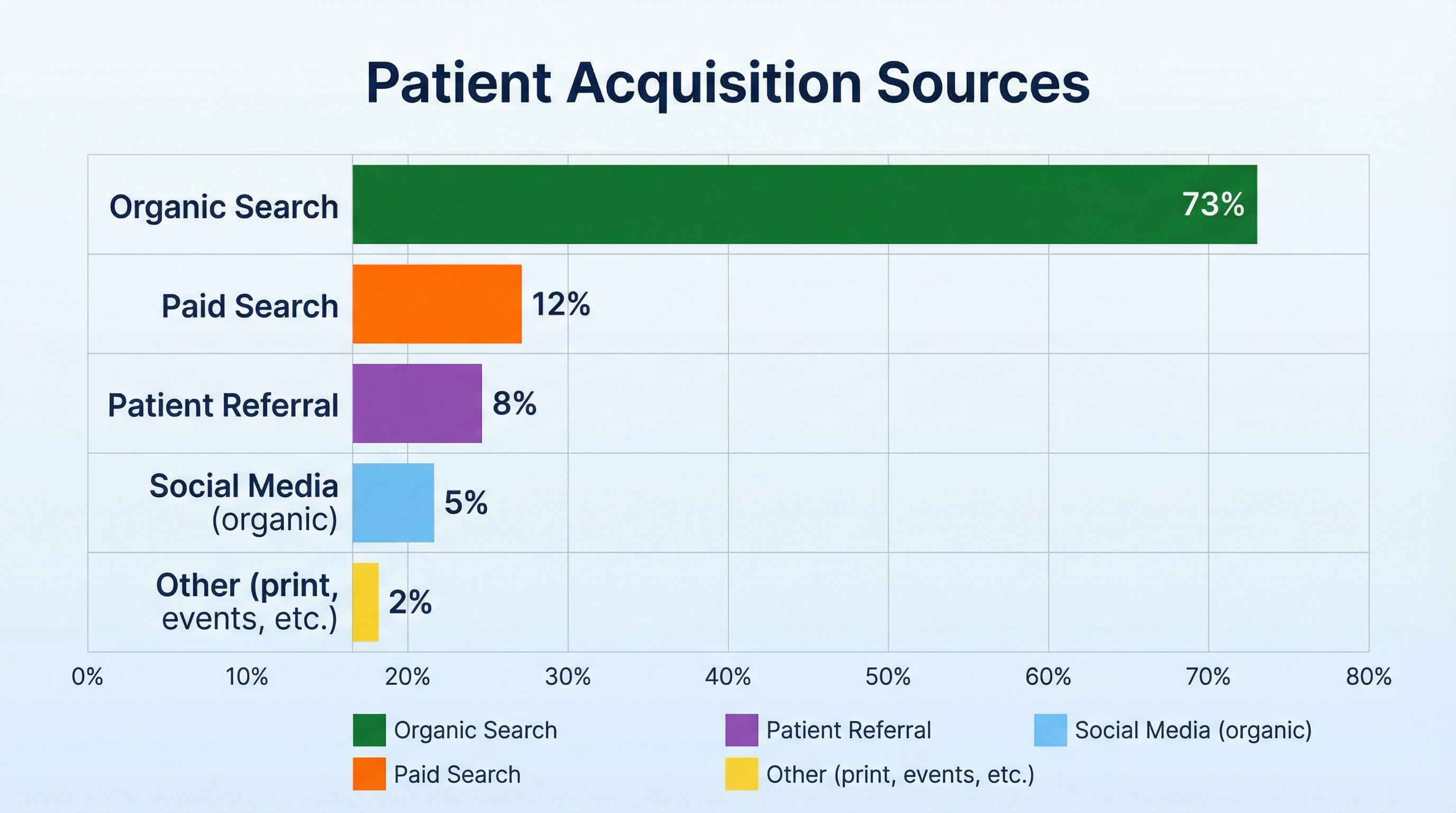
Chart: Where New Consults Actually Come From (2026)
Straight Answers to Surgeons’ Toughest Questions
No hedging. No “it depends.”
Five years ago, agencies built generic “plastic surgery” websites with 50‑page procedure directories and hoped Google noticed. That era is over. Today, Google evaluates whether you are the definitive answer for a specific procedure in a specific geography—but we’ve engineered our process to adapt instantly to any geography. We don’t build 50 thin pages. We build 15 deep, evidence‑rich content clusters around the procedures that actually drive your revenue, then localize them for your DMA. We also measure success differently: not by keyword rankings, but by branded search volume. When patients search for your name – that’s the metric that correlates with practice growth, whether you’re in Manhattan or Montana.
Referral‑dependent practices are one retiring colleague away from a 30% revenue drop. Moreover, the patients you get from referrals are often less profitable – they’ve already been “sold” by the referring doctor, so they’re less loyal and more price‑sensitive. Digital patients, by contrast, have done their own research and chosen you specifically—and this holds true in every region we’ve tested. They rarely haggle and they refer their own friends. The surgeons we work with don’t abandon referrals; they add a digital channel so they control their own destiny, regardless of local referral networks.
No. We provide a monthly recommendation based on your consult capacity and revenue goals. Some months we advise holding spend flat. Others we identify an opportunity to scale. We’re compensated on a flat monthly fee plus a small percentage of ad spend – so we have no incentive to recommend wasteful spending. Our average client spends $12k–$25k monthly on ads; we’ve never pushed a client above their comfort zone. The island: we succeed when you achieve your target ROAS, not when you maximize your ad budget. This philosophy works in small towns and big cities alike.
We never touch PHI. Our content management system is HIPAA‑ready, but we don’t store patient records. For before/after photos, we only publish images with written, signed consent forms that you provide. We also ensure that our ads comply with the ASPS Code of Ethics and FDA guidance for medical devices. We view compliance as a differentiator, not a burden. The takeaway: your reputation is safe with us—in every jurisdiction we serve.
Ready to Fill Your Consult Calendar With Ideal Patients?
The majority of plastic surgeons wait until a slow month to think about marketing. By then, it’s a 6‑month recovery. We offer a 45‑minute Strategy Session where we review your current digital footprint, identify the three highest‑opportunity procedures for your specific market, and project the consult volume you could expect from a disciplined 12‑month effort. There’s no pitch, no obligation, and no generic PowerPoint. You’ll leave with a concrete roadmap tailored to your city, your competition, and your demographic realities. If it makes sense to work together, we’ll discuss it. If not, you still have a plan. The island: you have everything to gain and only 45 minutes to lose.
We Build. You Succeed.


© 2026 NV Marketing Co - All Rights Reserved,
© 2026 Company Name - All Rights Reserved, consectetur adipiscing elit. Maecenas commodo suscipit tortor, vel tristique sapien